
I’ve been photographing fireworks for several years now. After a lot of trial and error, I’ve gotten to a point where I am quite comfortable of being able to pull of good fireworks images on any day of the week. Having gotten to this stage, I felt that the time was right to put together a guide to photographing fireworks.
The charm about fireworks is that you never really know what you’re going to get. As a result, they can be tricky to photograph, and just as tricky to post-process.
Now to get good images of fireworks, you’re going to need a camera where you can control the shutter speed, and a means to keep it absolutely still.
The choice of camera and lens
You will need to choose a camera that has good low light performance, and will allow you to manually adjust the ISO, shutter speed, and aperture. This logically points to an SLR (and given that this article is aimed at an audience that primarily shoots in digital format, I will go as far as to say a Digital SLR), or a micro-four-thirds camera. There are some high end point-and-shoot models that will also give you this sort of control. The key limitation will be their performance in low light and high ISO settings.
Fireworks shows are a special case of landscapes. Hence you’ll want to choose a lens that is fairly wide – typically on the lower side of 50mm.
Keeping the camera still
As you’ll be shooting an illuminated subject that moves against a predominantly still background, you will need to keep the camera still. There are two parts to this.
First, you’ll need a good sturdy tripod. The second part to this (while not essential) is to have a means to remote trigger the camera to prevent vibrations. This can either be a cable release, an infra-red remote, or a built in timer.
I use a Canon 5D Mark II with a custom firmware installed on it (Magic Lantern) which gives me the functionality of an intervalometer, where I can tell the camera to continuously shoot frames at set intervals indefinitely.
Camera Settings
As with all forms of photography, I always recommend shooting in RAW. This is so that you can manipulate things such as the white balance, exposure, contrast, highlights and shadows, and white and black points in post-production, which you will not be able to do if you shoot in JPEG.
Now, there are a lot of theories out there, but my experience has taught me that three key things to consider about capturing good fireworks images are
- the focus,
- the exposure time, and
- the ISO.
Once you have these three items sorted, the aperture typically sorts itself out. Now a typical fireworks display is really a landscape shot taken in low light. The main subject – the fireworks display – is typically quite far off from where one would be stationed. When it comes to focus, I’ve taken the route of using the camera lens manually focussed at infinity. By doing this, we’re going to take advantage of the camera’s hyper-focal distance. That means that beyond a certain distance (usually, a few metres), everything will be in acceptable focus.
Selecting the exposure time is tricky. Expose for too long, and you’ll end up blowing out the highlights and ending up with no details. Expose for too little, and you won’t get very much at all. I find that the best exposure times are between 4 to 12 seconds. However, picking out what works best does require some trial and error.
The selection of the ISO number is dictated by your camera’s sensitivity to light. Because you’ll be shooting in low light conditions with relatively short exposure times, you will need to shoot at a high ISO number. I usually shoot at around 800 ISO, but you may be limited by your camera’s sensitivity to noise. I recommend choosing the highest ISO number that you feel that your camera will produce good, relatively grain-free images with.
Now, once you’ve got your camera set, you’ll need to take a few test shots, while varying the aperture till you get an image that you feel is adequately well exposed. You would do this before the fireworks went off and the area was still
limit in ambient light. Now, bearing in mind that when the fireworks go off, the light levels will increase, you will need to adjust the aperture (increase the f-number) to accommodate for this increase in light. My rule of thumb is to double the f-number, and then reduce it by half a stop.
So, if I had ascertained that I could capture a correctly exposed image of the area before the fireworks went off at f/4, I would set my aperture to f/7.1 (4×2=8; and a half-stop down from f/8 is f/7.1). Similarly, if I found that I could capture a correctly exposed image of the area before the fireworks went off at f/8, I would set my aperture to f/13.
Shoot
At this stage, you’re set. Once you have your camera settings programmed in, wait for the fireworks to go off, and then start shooting. Shoot often, and do not move the camera around. The beauty of using a cable release or intervalometer when doing this (in addition to getting good images) is that you will actually be able to enjoy the fireworks display with your own eyes instead of watching it through a view-finder!
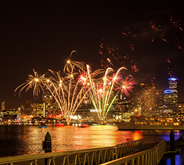
If you’ve done this, you should be able to pull off images like these from your shoot.
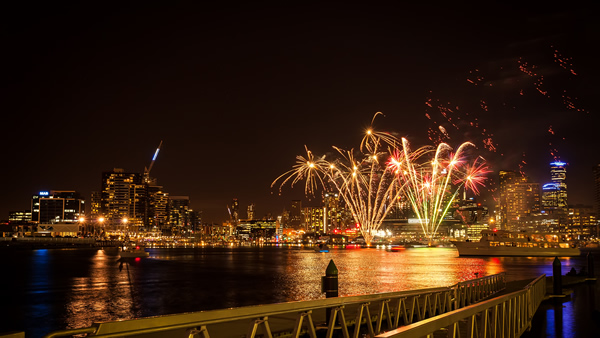
Fireworks in July from the bottom of North Wharf Road
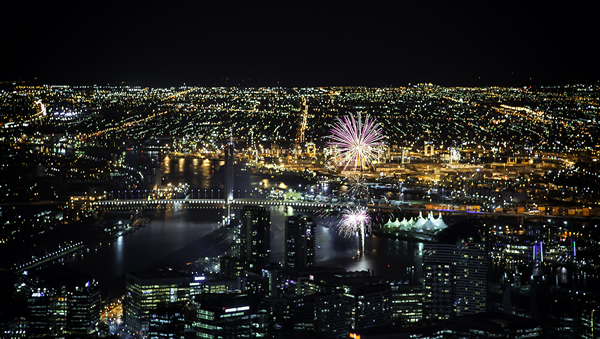
Fireworks in July over Victoria Harbour – August 2013
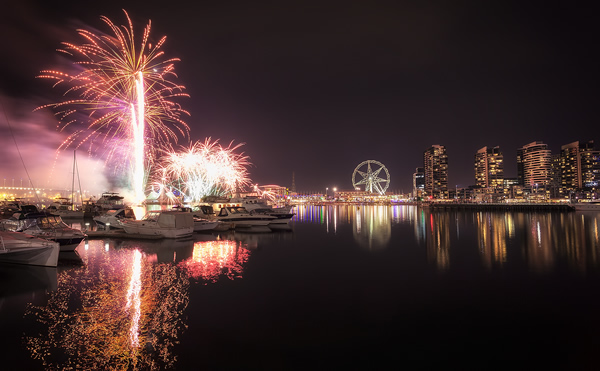
Fireworks in July over Victoria Harbour – Starburst Cluster
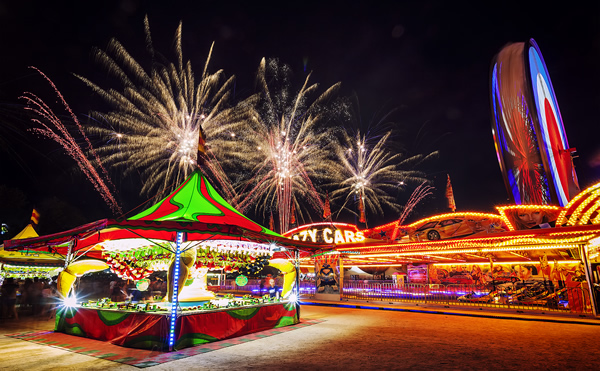
Moomba – The Crazy Car Square
Post Processing
Now, the images above didn’t come out of camera that way, but have been post-processed. I use Lightroom, Photoshop and Noiseware to post-process my images. I have a set of custom presets which I have built that allow me to apply these adjustments with a single click in Lightroom. The video above shows the exact post-processing sequence that I use to finish off my images as a final product.
Some Final Thoughts
While I’ve covered the camera techniques and post-processing workflow in the segments above, there are a few things to keep in mind when going out to shoot fireworks that I call the “pre-work”.
- Scope the location of the fireworks display out a few days in advance, and pick your vantage point so that you have a clear view of fireworks.
- Check the weather forecast, and specifically, the speed and direction of the wind as this will affect how your images turn out. Ideally, you want the blowing across the direction that you will be looking directly out towards.
- Dress appropriately for the weather. You will be standing around for close to an hour. On cold days, you will want to bundle up. On warm days, you may want to have something to fan yourself with. Always keep some drinking water and a small towel handy.
- Plan for traffic and come early. Fireworks displays attract crowds, and if you do not get there early, you may struggle to find a place to park, and secure a vantage point to shoot from.
- Carry a torch/flashlight. You will shooting in predominantly dark surroundings. Having a light source is invaluable when you happen to drop something like a lens cap, and are struggling to find it.
- Above all, don’t spend all your time tinkering with your camera. Do try to enjoy the display
About the author:
Debashis Talukdar is an Australian based IT professional and landscape and travel photography enthusiast. His focus is on landscapes and cityscapes in High Dynamic Range Photography, and Time-Lapse Photography. Debashis is a self-taught photographer who has been shooting seriously since 2006. His images have been featured on Australian Geographic. He regularly posts both new photographs and newly post-processed older photographs on his website at doubleconvex.com
He is on the following social networks: