
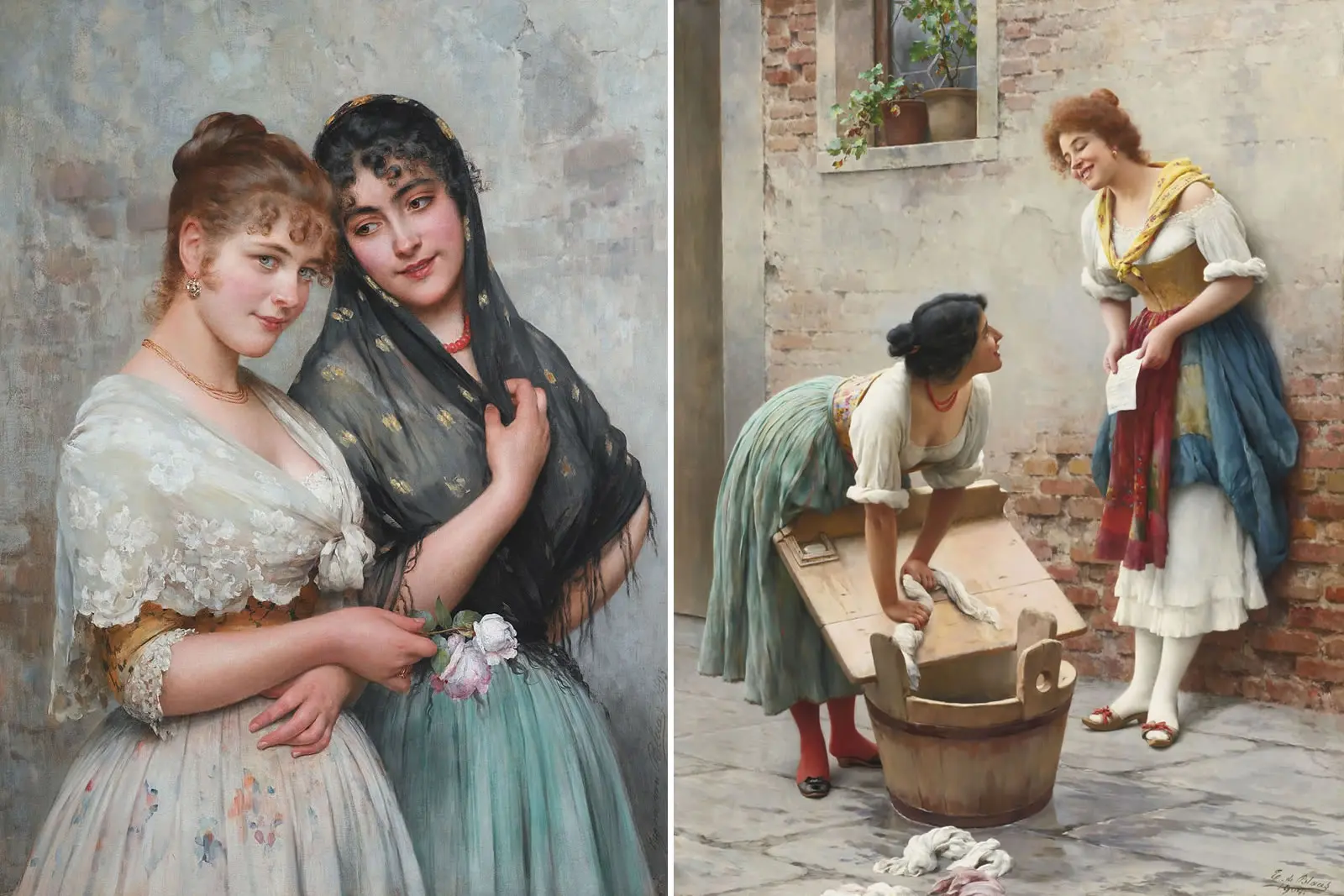
Imagine strolling through old Venice — the sun glinting off winding canals, merchants hawking fruit near crumbling palazzi, and ladies in silk skirts chatting with suitors on cobblestone bridges. Now, freeze that moment in paint, turn up the color, and add a dash of theatrical elegance — that’s basically the magic of Eugene de Blaas. Born on July 24, 1843 in Albano near Rome, this Austro-Italian artist got schooled in the old-world precision of Academic Classicism by none other than his dad, Karl von Blaas, who was a big deal painter and teacher himself.
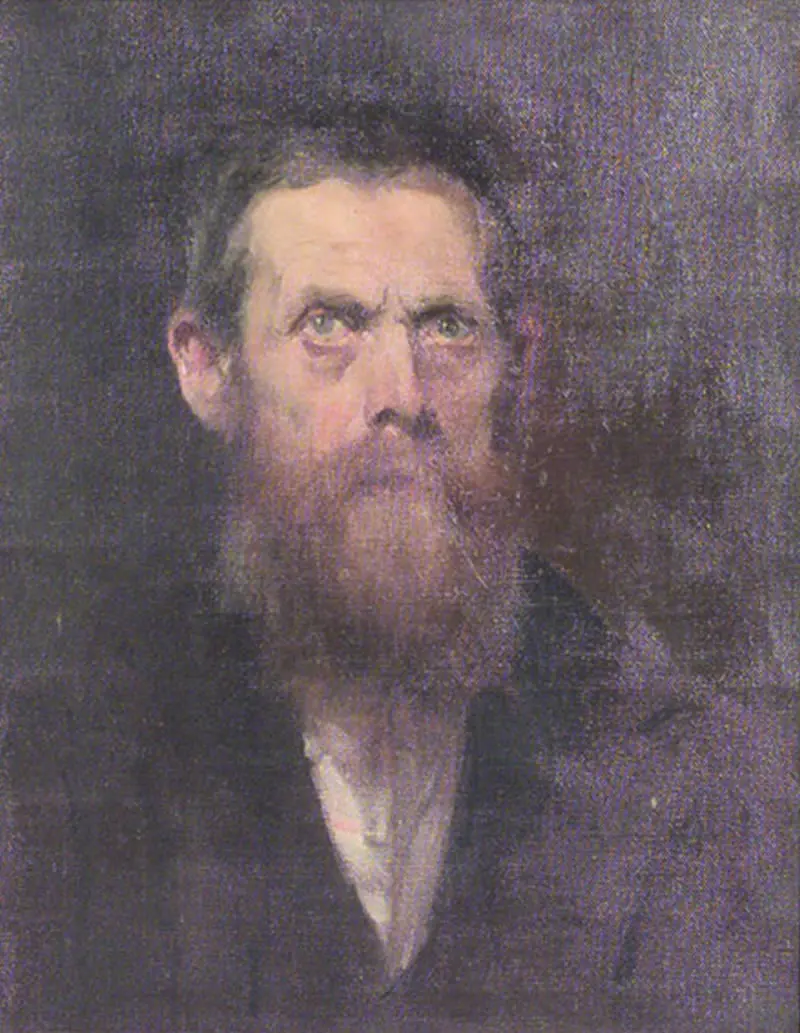
Self Portrait of Eugene de Blaas
Eugene didn’t just copy life — he elevated it. When his family moved to Venice after his father got a gig teaching at the Venetian Academy, young Blaas was plunged into a city pulsing with poetry, processions, and daily drama. He took everyday scenes — flirtatious glances between lovers, peasant girls hauling water, gondoliers at their oars — and spun them into polished, radiant works that felt like snapshots of an idealized world, yet packed with human warmth and real-world texture.
Unlike modernists chasing abstraction or shock value, De Blaas stayed devoted to craft — blending smooth brushwork with rich colors and theatrical compositions that made his characters seem alive. His work earned him applause across Europe, from London’s Royal Academy to galleries in Vienna and Munich, and stamped him as one of the most beloved genre painters of his age.
This article breaks down De Blaas’s journey, genius, and why his paintings still feel alive today — like stepping into a Venetian dream you never wanna leave.
You can find Eugene de Blaas on the web:
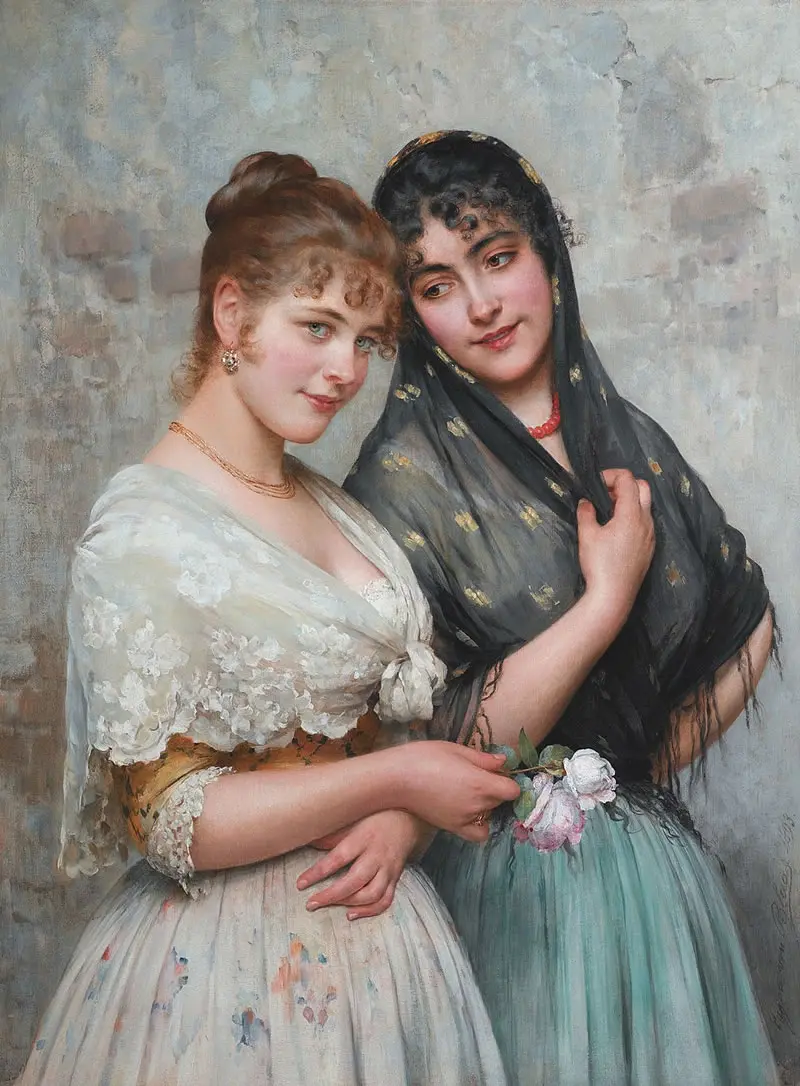
#1. Two Venetian Women
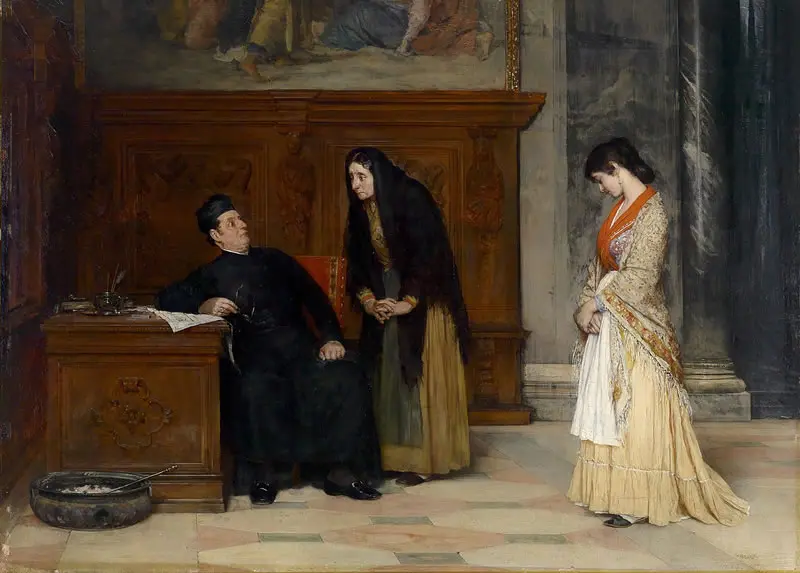
#2. In the Sacristy, 1877
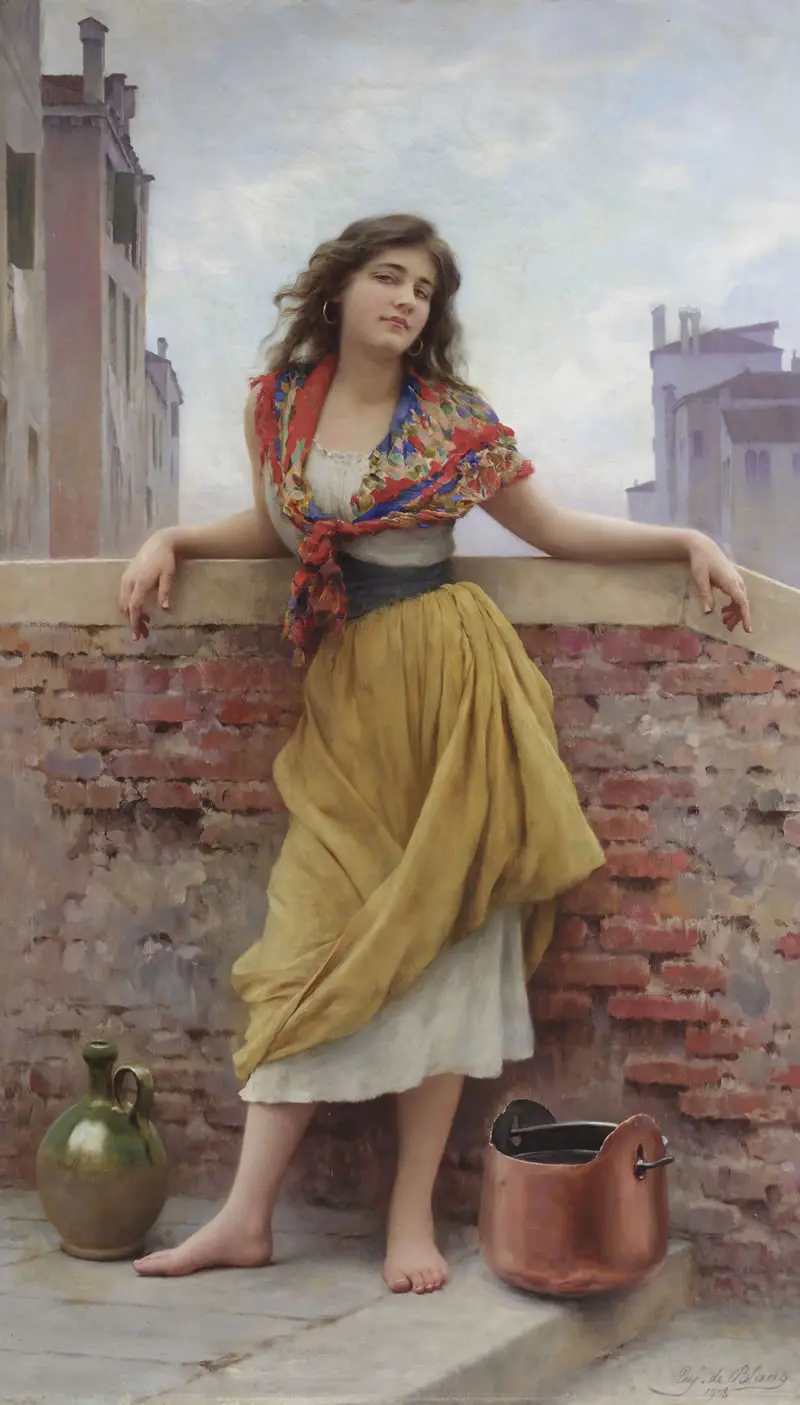
#3. The Watercarrier
Life & Venice Beginnings – The Making of a Painter
Eugene de Blaas was born into creativity — his father, Austrian-born Karl von Blaas, taught him the fundamentals of drawing, composition, and color. The family’s move to Venice — one of Europe’s artistic capitals — set the stage for Eugene’s story. Venice wasn’t just scenery, it became part of his artistic DNA: the water, the architecture, the everyday bustle provided endless inspiration and narrative opportunities.
He absorbed the city like a sponge — studying classical techniques and how to make light dance on surfaces, whether carved stone or silky fabric. By his late teens, he was already exhibiting in Venetian circles, practicing a genre blend of realism and elegance that became his trademark and helped him stand apart from many of his contemporaries.
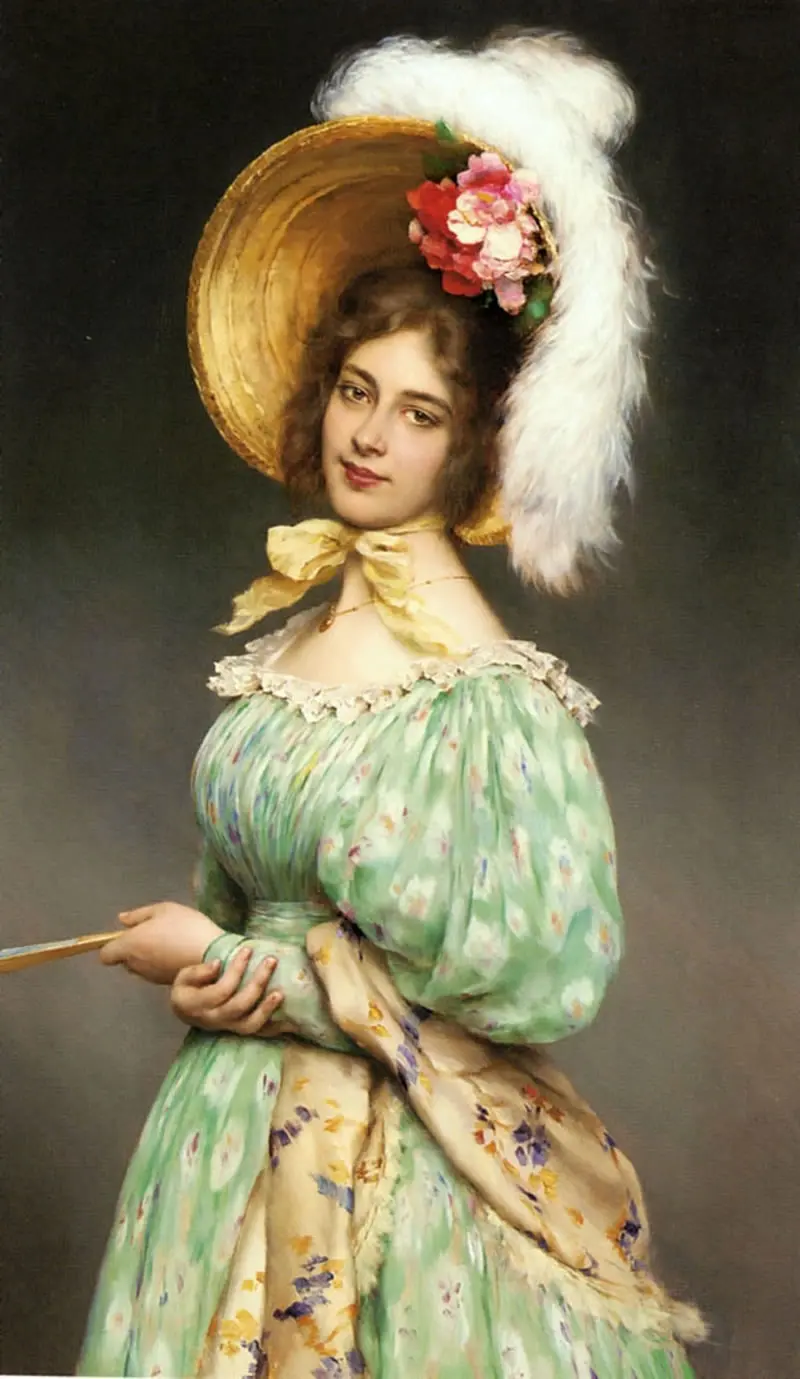
#4. De Musette
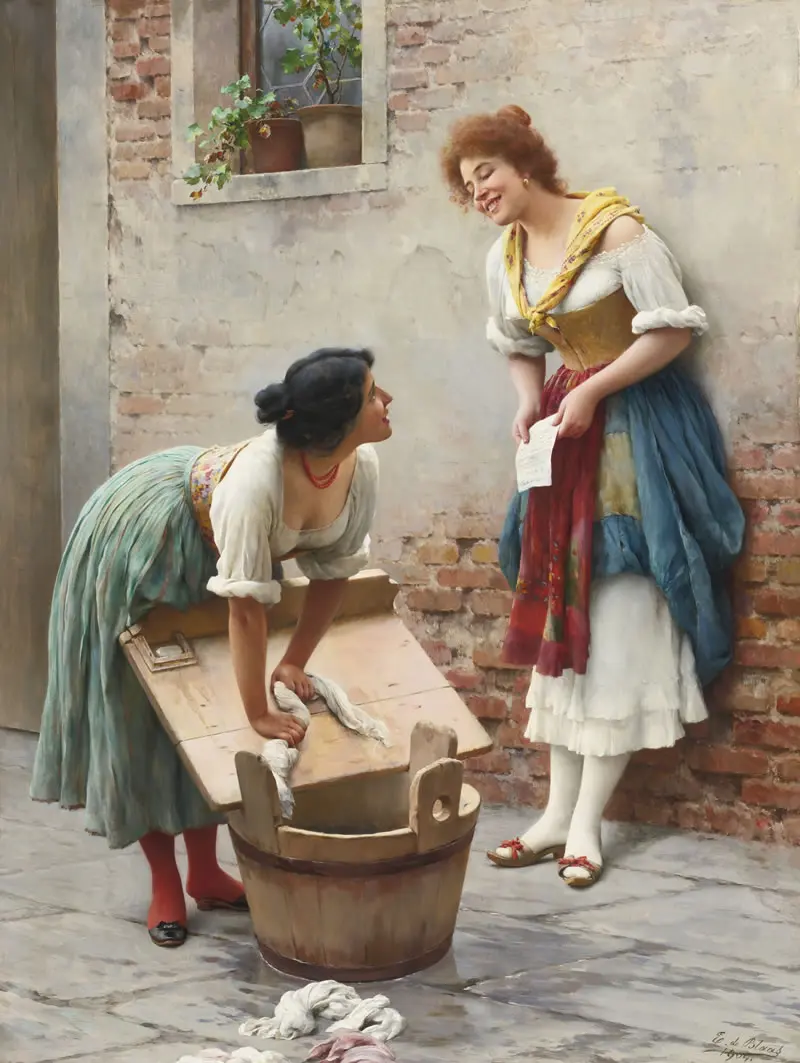
#5. Sharing the News
#6. The Spider and the Fly
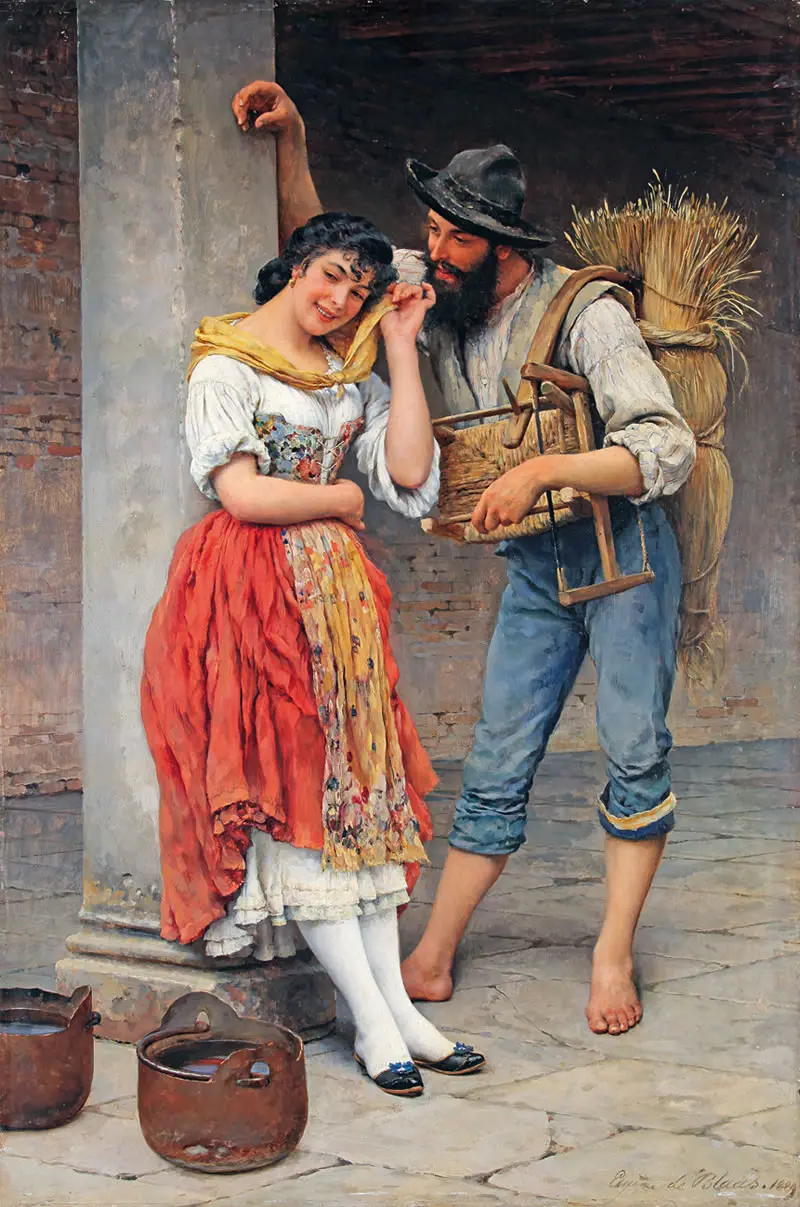
Signature Style & Themes – Where Life Meets Art
What makes De Blaas’s work instantly recognizable? It’s his masterful attention to detail and his passion for capturing life’s little moments. He worked in the Academic Classicism school, which means technical precision and beautifully finished surfaces, but his subjects were anything but stiff.
Everyday Venetian scenes — flirtatious exchanges, market stalls, ladies with flower baskets — were his bread and butter, and he painted them with warmth and narrative flair. He used oil on canvas to build layers of luminous color, turning simple street life into scenes that feel warm, alive, and beautifully intimate. Romanticized yet grounded in everyday humanity, his pieces are like storytelling snapshots — each figure seems to have a personality, a fleeting expression, a story in motion.
#7. Daydreaming
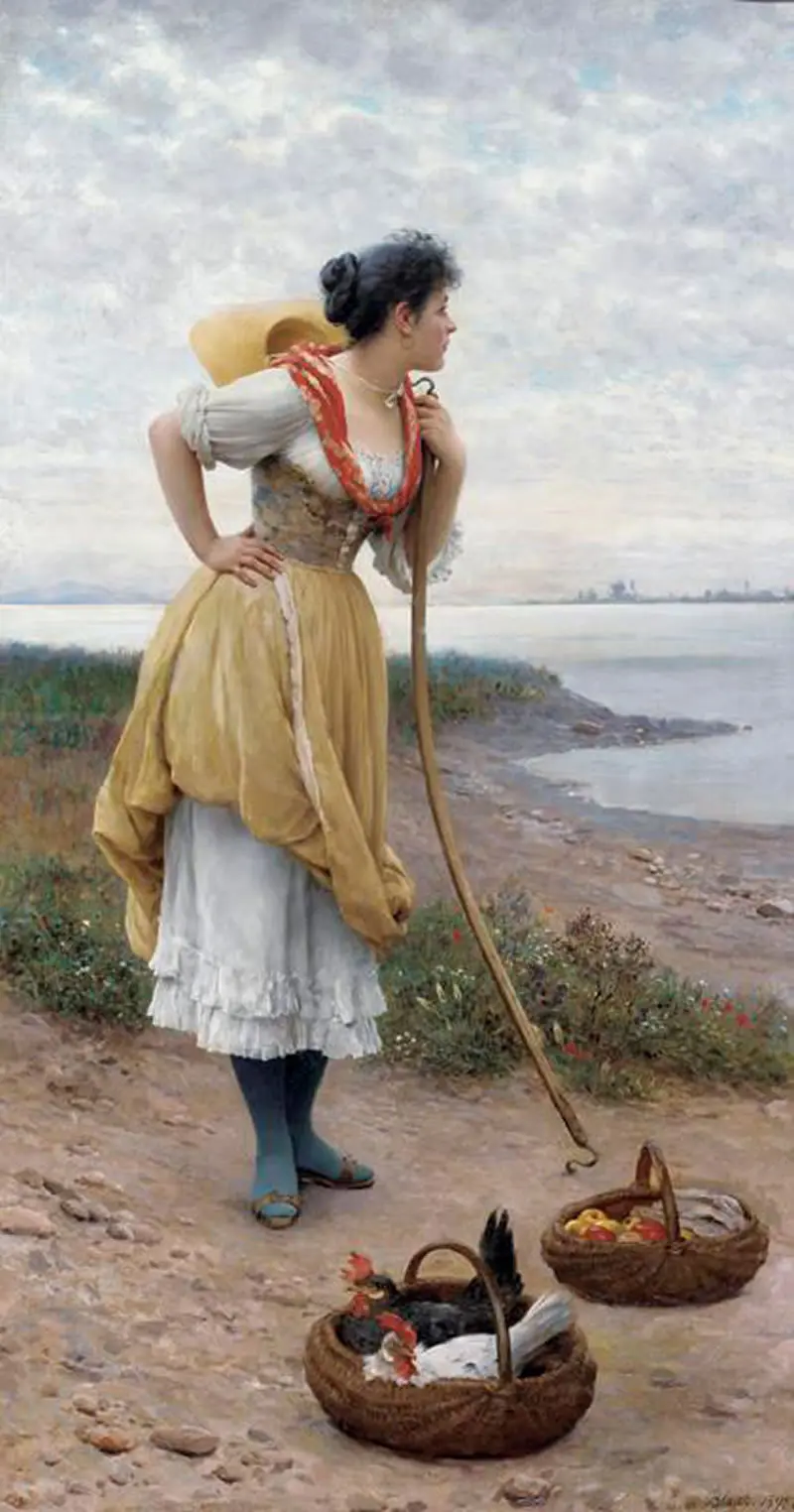
#8. The Flirtation
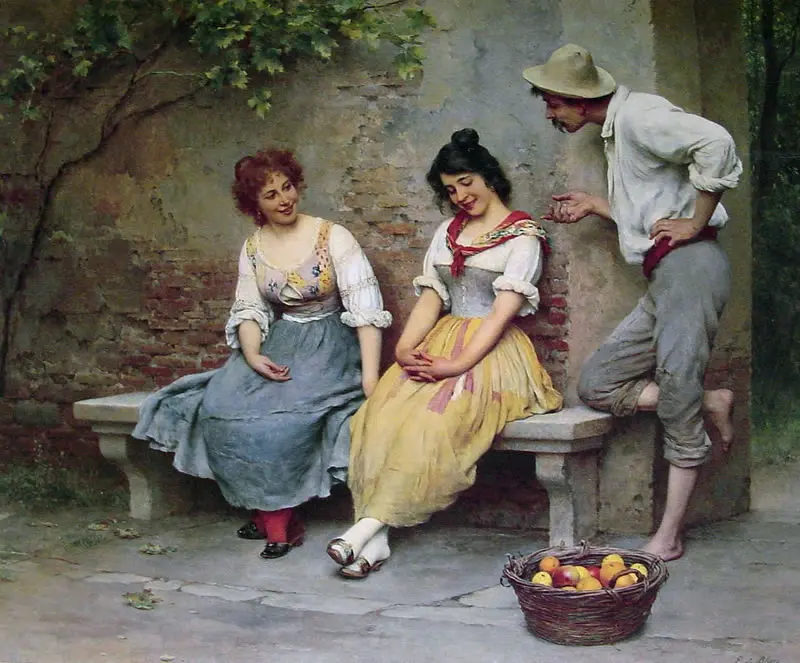
#9. Curiosity
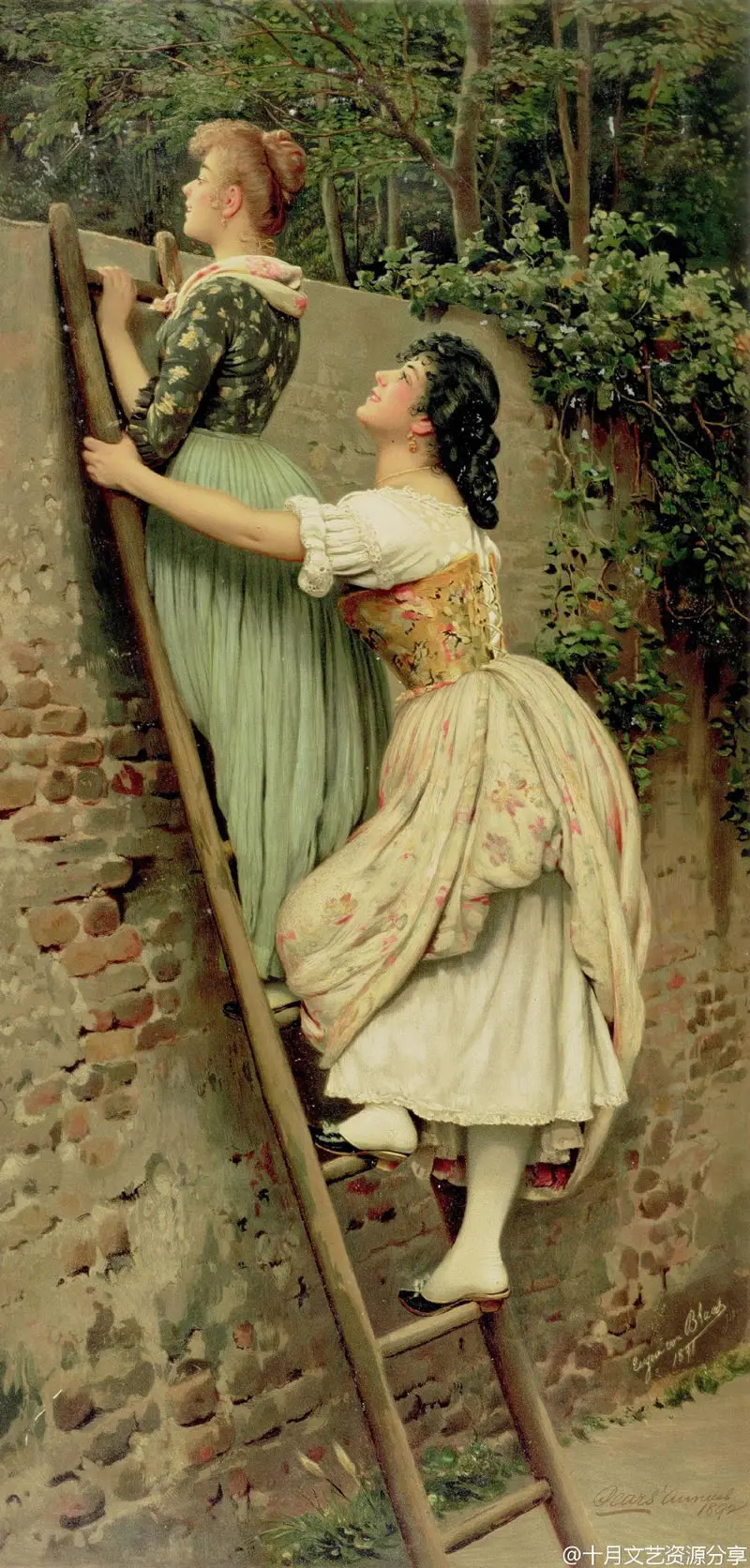
Famous Works & Artistic Highlights
De Blaas left behind a treasure trove of paintings that art lovers still gush over. Famous pieces like On the Balcony (1877) display his eye for theatrical staging and radiant color, while everyday scenes like The Watercarrier speak to his love for capturing real people in real moments. Another standout is In the Water (1914), one of his rare nude works that features soft light and glowing skin tones — an intimate departure from much of his otherwise fully clothed scenes.
Paintings such as The Love Letter, The Flirtation, and A Pensive Moment showcase his narrative strength — every canvas is like a short story told with form and light. His ability to entwine composition, color, and emotion allows his work to bridge technical mastery with an irresistible storytelling vibe.
#10. The Red Fan
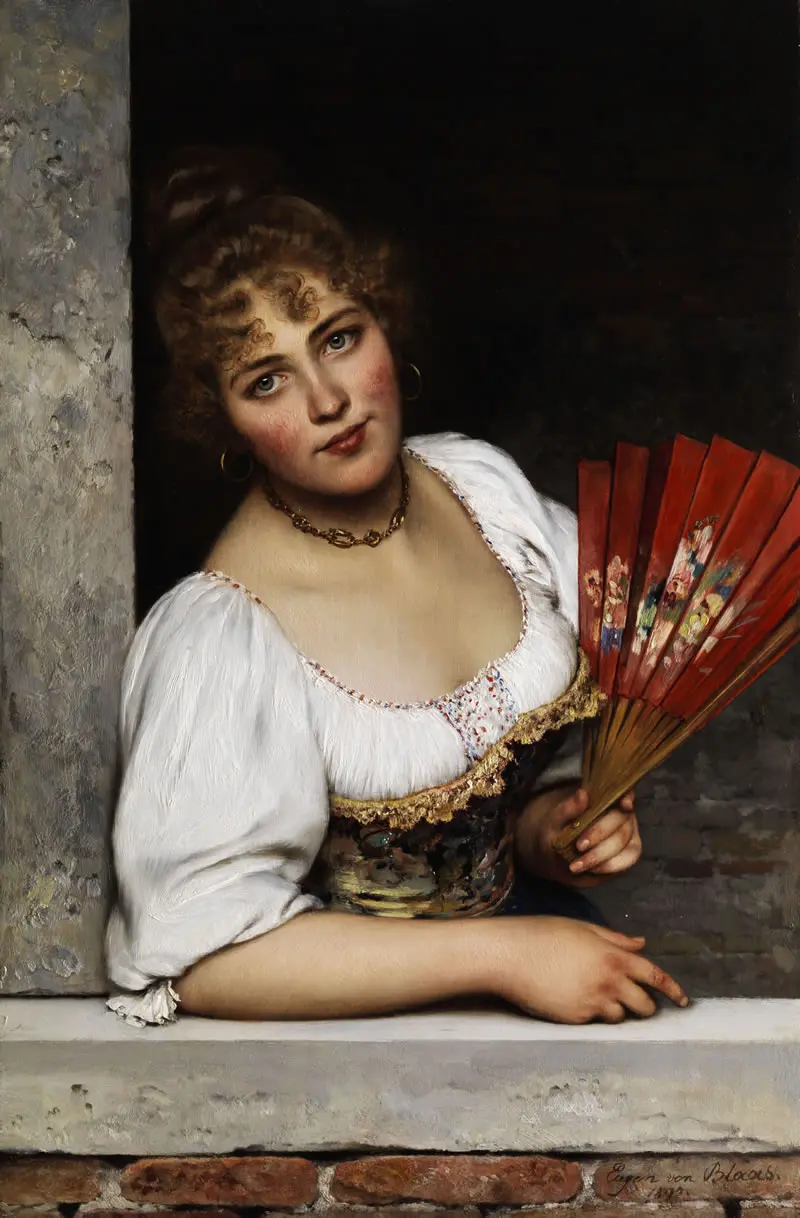
#11. A Pensive Moment
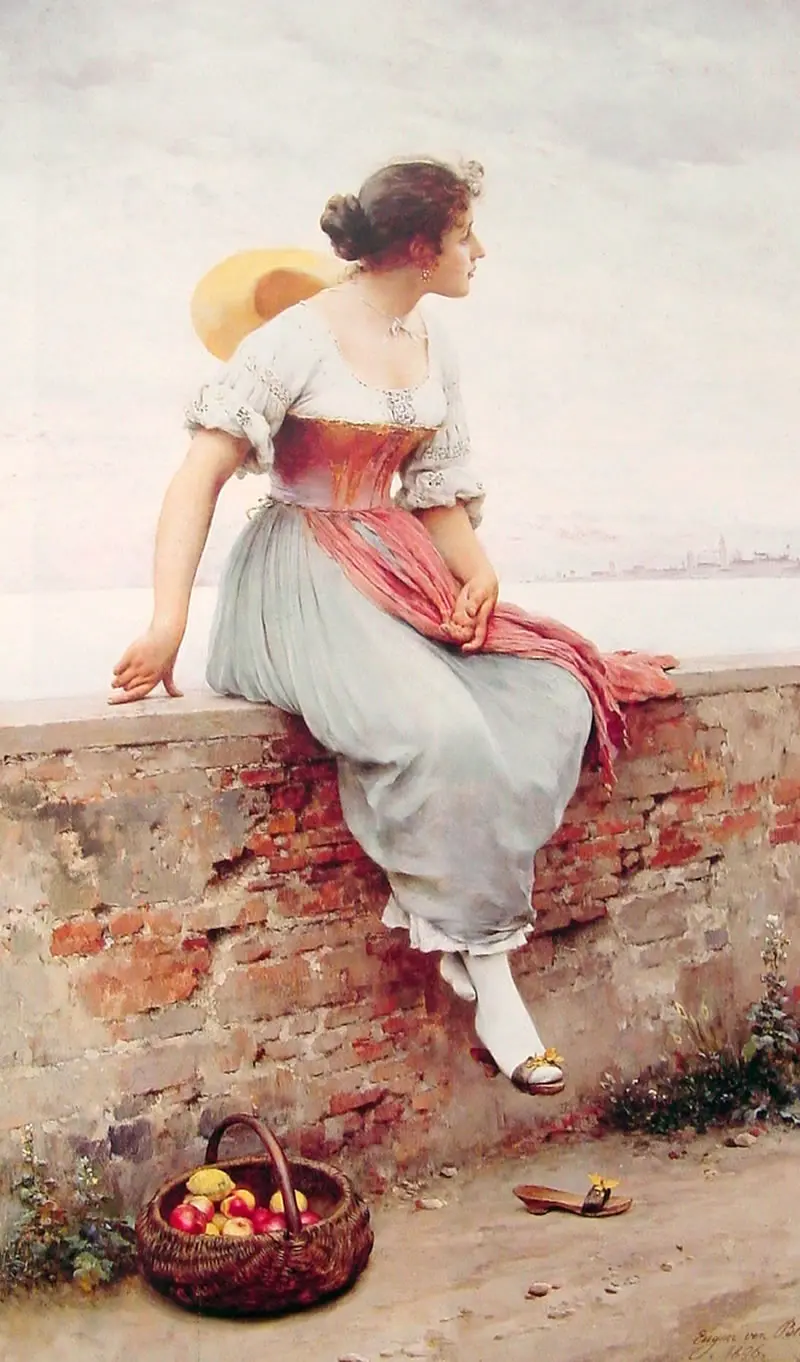
#12. An interesting Story
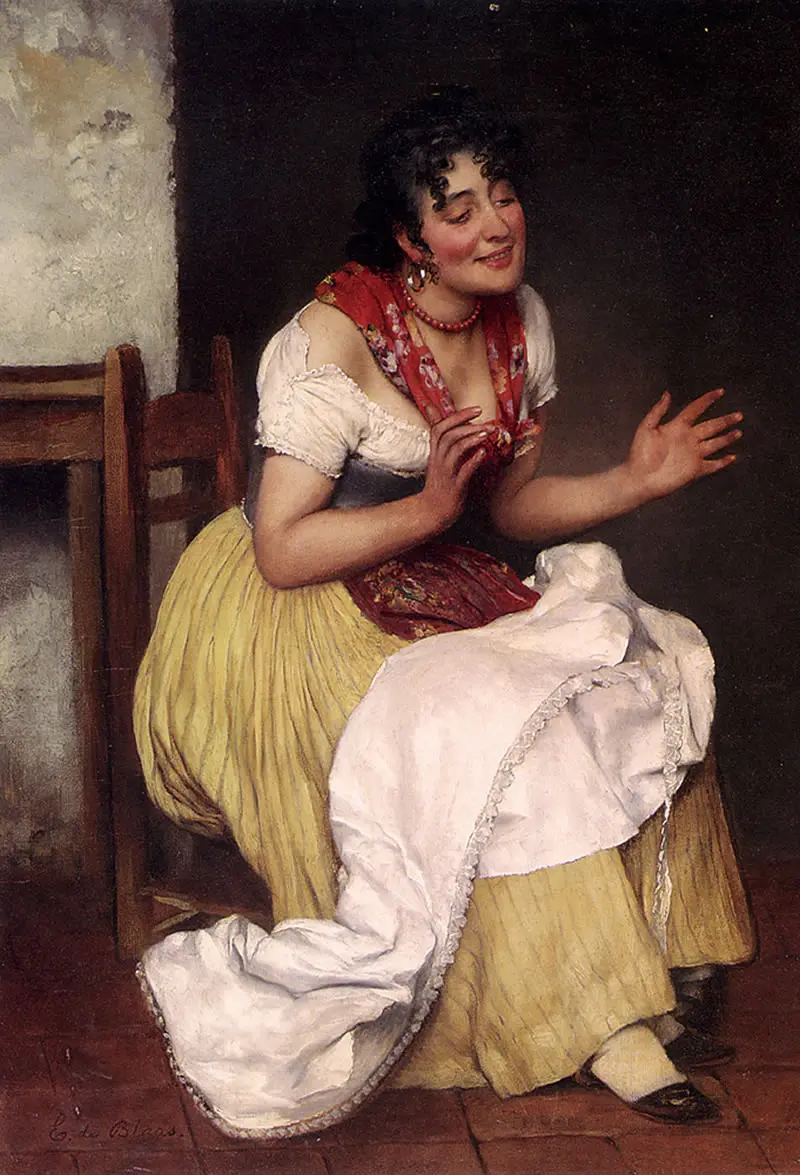
Exhibitions & European Acclaim
De Blaas didn’t just make waves in Venice — his art made big ripples across Europe. He exhibited at prestigious venues like London’s Royal Academy, the Fine Art Society, the New Gallery, and the Walker Art Gallery in Liverpool. These platforms introduced his work to art collectors hungry for craftsmanship and beauty, helping solidify his reputation across Britain, Austria, and beyond.
Unlike some artists of his time who chased avant-garde styles, De Blaas stayed true to elegance and narrative — a choice that garnered him consistent critical appreciation and collector demand. Galleries valued his compositions for their polished finish and evocative storytelling, making them favorites among those who preferred technical excellence wrapped in poetic scenes.
#13. The Water Carrier
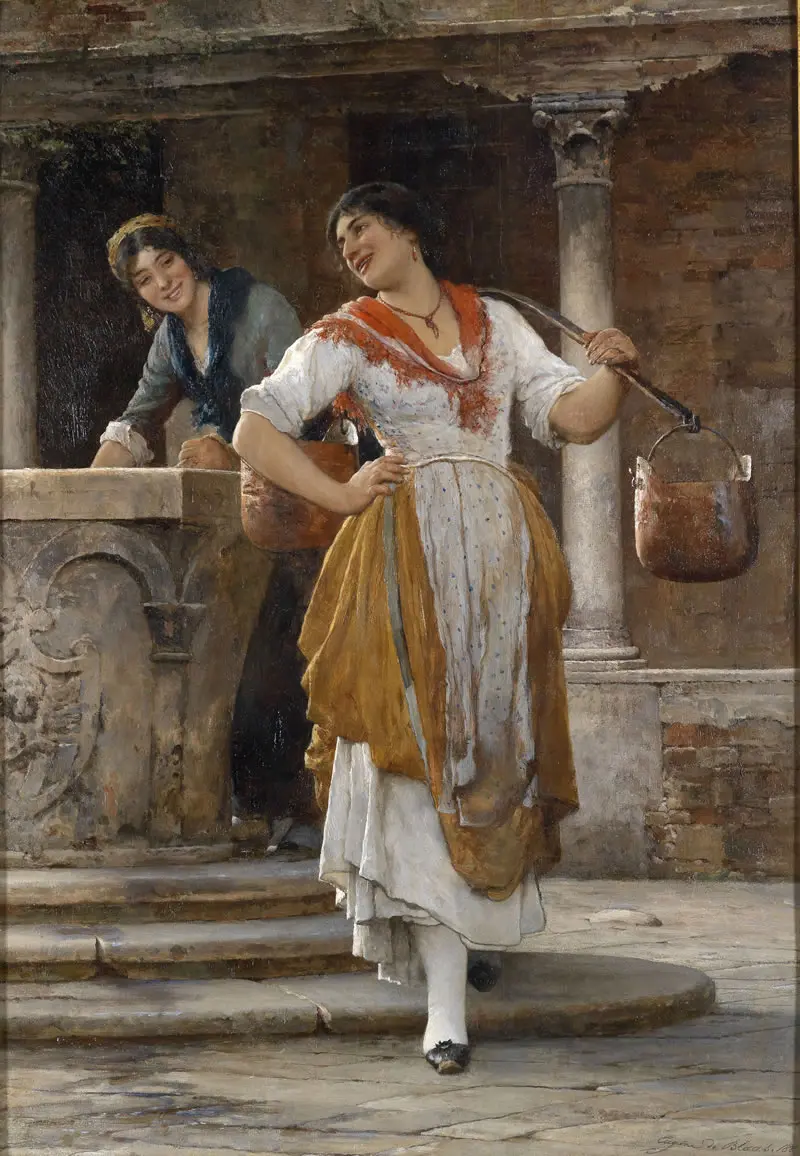
#14. Chat
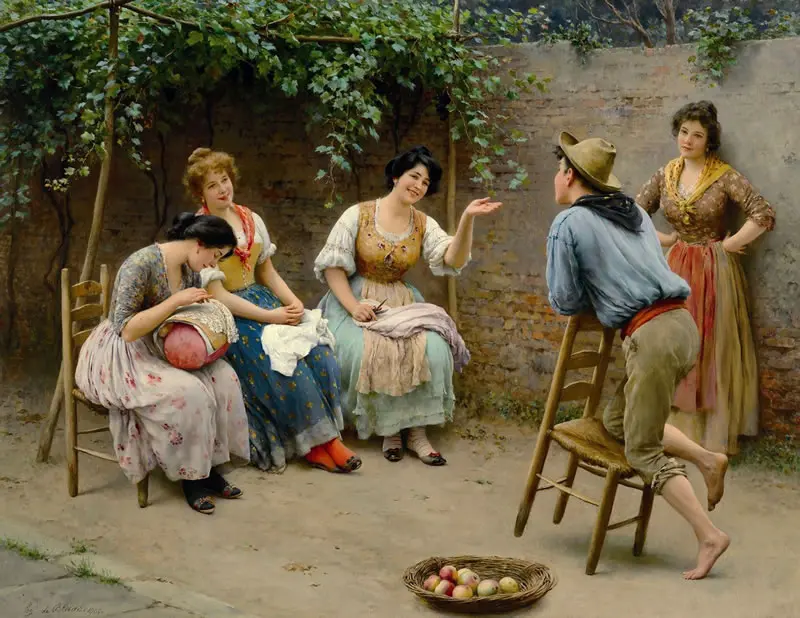
#15. On the Beach
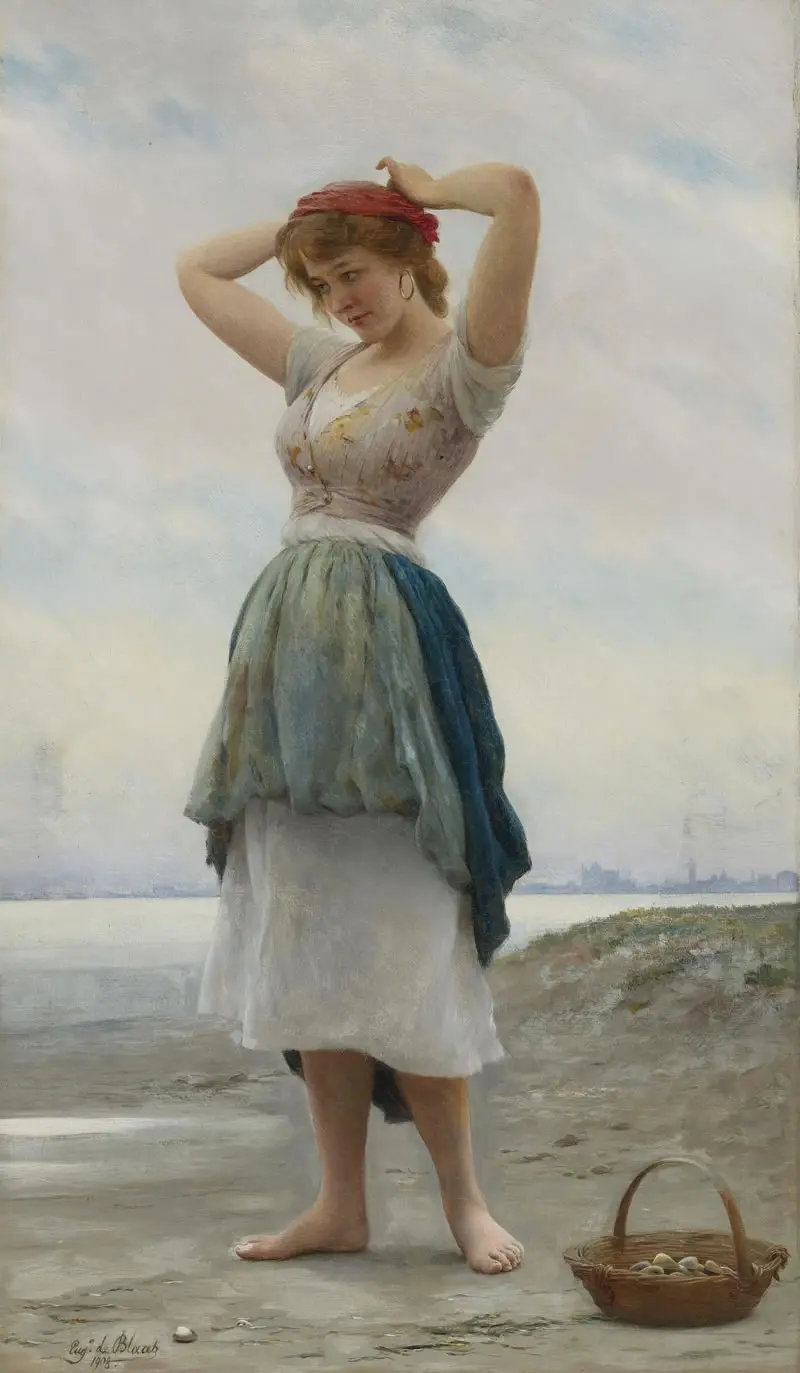
Legacy – Why De Blaas Still Matters
Eugene de Blaas might not be a household name like some modernist legends, but his impact on genre painting remains big and beautiful. He helped sustain Academic Classicism into the early 20th century, showing that finely crafted, evocative scenes of everyday life could still captivate modern audiences.
His work continues to be collected, studied, and cherished because each painting feels like a moment frozen in time — one full of emotion, light, and narrative depth. Today, art lovers still admire his ability to make everyday people look heroic, charming, and unforgettable, and his portrayals of Venetian life serve as a timeless visual diary of a city and era that continues to enchant.
#16. God’s Creatures
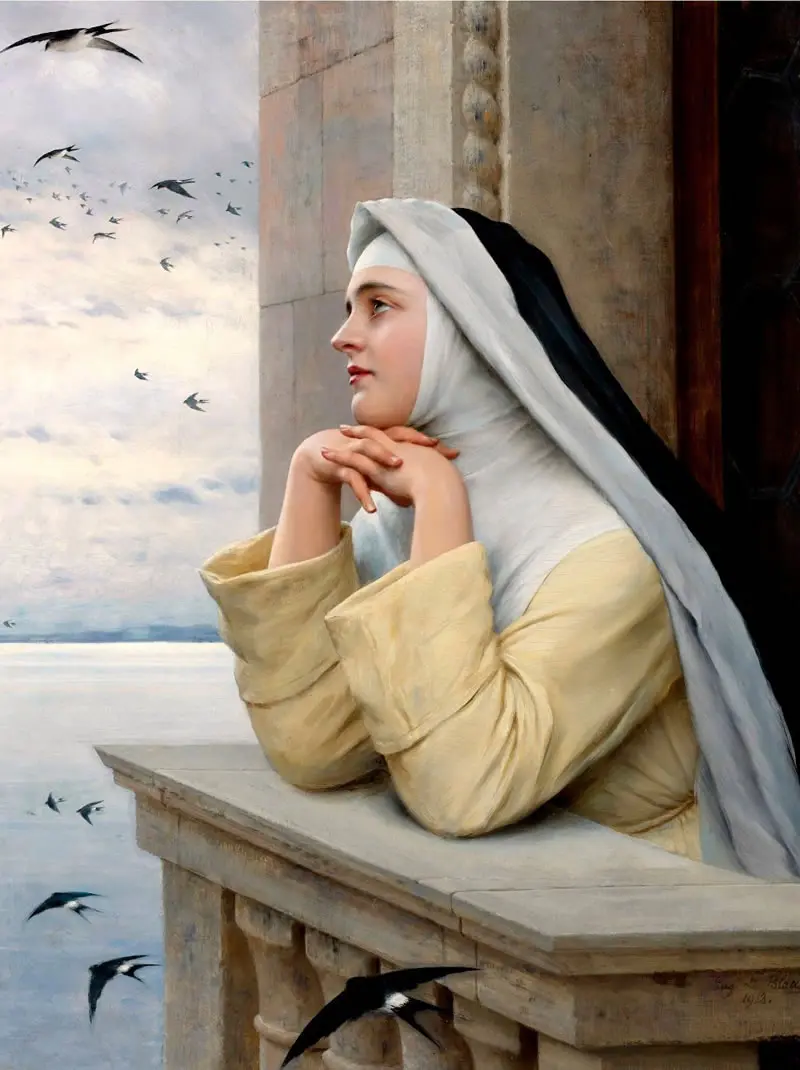
FAQs
Who was Eugene de Blaas?
An Italian painter known for vivid genre scenes in Academic Classicism style, born in 1843 and associated with Venetian subject matter.
What style did he paint in?
Academic Classicism — polished, detailed works celebrating everyday life and beauty.
What are his most famous themes?
Elegant Venetian scenes, women in domestic settings, and narrative genre moments.
Where was his art shown?
Exhibited across Europe, notably at London’s Royal Academy and galleries in Liverpool.
Why is his work still relevant?
His paintings offer timeless beauty, technical mastery, and emotional storytelling that continues to charm audiences.